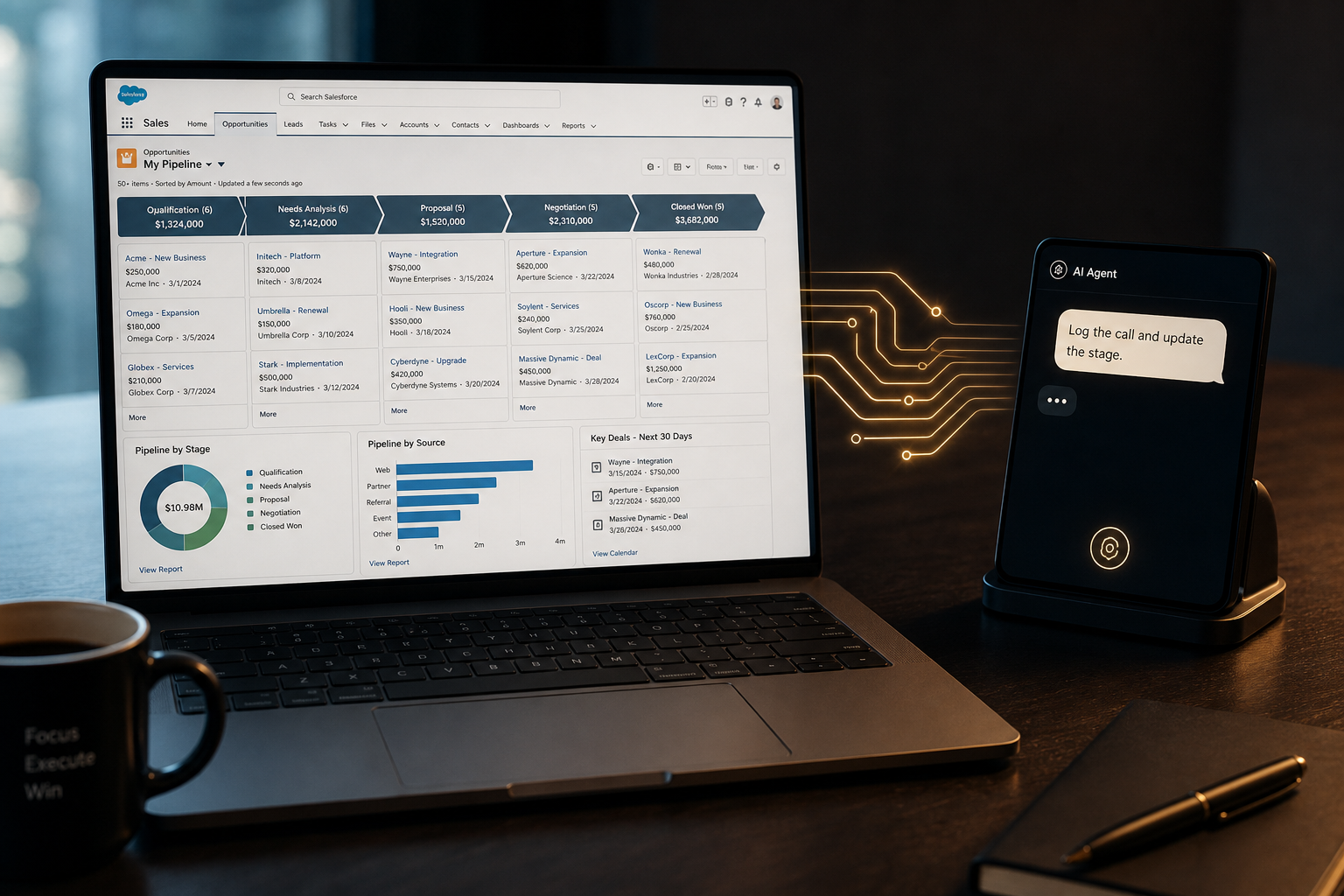
Imagine this. Your sales rep finishes a call with a client. They don't open Salesforce. They don't type a summary. They don't set a reminder. Instead, they say to their AI assistant: "Log that call, update the opportunity stage, and draft a follow-up for Thursday." The AI opens Salesforce, reads the account, updates the record, and puts a draft in the rep's outbox — in under a minute.
This is not a vision for 2030. This is what Salesforce's new MCP Skills capability makes possible today. And whether or not you care about the technology, the business implications are worth understanding.
What MCP Skills Actually Are
MCP stands for Model Context Protocol — a standard that allows AI tools to connect to external systems and act on them, not just talk about them. When Salesforce releases MCP Skills, it means that AI assistants like Claude, Copilot, or any compatible AI tool can be given a set of defined actions they can perform inside Salesforce.
These aren't vague "AI integration" promises. They're specific, governed actions: read a contact, create an opportunity, update a field, find accounts that match certain criteria, log a call activity. The AI doesn't just know about your Salesforce data — it can work with it.
For a business leader, the relevant question isn't "how does this work technically?" The relevant question is: what does this mean for how my teams operate — and are we in a position to benefit from it?
The Shift This Creates
Today, your team goes to Salesforce. They navigate to a record, fill in fields, create activities, run reports. The tool is passive — it waits to be used.
With MCP Skills, the relationship inverts. Your team talks to an AI assistant about their work — in natural language, from wherever they are — and the AI goes to Salesforce on their behalf. Salesforce becomes the back-end system that the AI operates, rather than the interface that people operate directly.
For sales teams, this means less time managing the CRM and more time in actual conversations. For operations teams, it means complex multi-step processes in Salesforce can be triggered with a single instruction. For managers, it means the data they need to run the business gets captured automatically — not because people were disciplined, but because the AI did it for them.
The shift in plain terms: Until now, AI could tell your team what to do in Salesforce. Now, AI can do it for them. That's a different kind of capability — and it has implications for every process that currently depends on people manually maintaining your CRM.
Where This Goes Wrong
I want to be direct about the risk, because this is where a lot of companies will stumble.
An AI agent that acts inside your CRM is only as reliable as the data and process structure it's working within. If your Salesforce data model has inconsistencies — pipeline stages that mean different things to different teams, fields that are rarely filled in, accounts with duplicate records — then an AI acting on that foundation will make decisions based on incomplete or contradictory information.
The AI isn't going to flag a messy data model as a problem. It will work with what it has. And "working with what it has" in a poorly maintained CRM means producing outputs that reflect the mess.
More concerning: when a human manually updates a CRM record incorrectly, the damage is contained to that record. When an AI agent performs bulk updates based on a flawed instruction or a misread context, the damage scales.
This isn't a reason to avoid the technology. It's a reason to sequence it correctly.
How to Know If You're Ready
Before activating AI agents in your CRM, three things need to be true.
Your data model reflects how your business actually works. Not how it was set up during implementation five years ago. Not a compromise between three different stakeholders' requirements. A current, accurate representation of how deals move through your pipeline, how customers are structured, and what information actually matters for decision-making.
Your adoption is already reasonable. If your team isn't using Salesforce consistently today, AI agents won't fix that — they'll work on sparse, unreliable data and produce sparse, unreliable outputs. The adoption problem needs to be solved before AI operates on the data. (This connects to an earlier post on why sales reps don't log data — the design problem comes first.)
You have a governance process for AI actions. Who approves what an AI agent is allowed to do in your CRM? What actions require human review before they're executed? What happens when an AI agent makes an error? These aren't rhetorical questions — they need real answers before you turn AI loose on live customer data.
The Opportunity for Companies That Are Ready
If those three conditions are in place, the opportunity is significant.
Sales teams that are currently spending 20–30% of their time on CRM administration can reclaim most of that. That time can go back into actual selling. Pipeline data becomes more current and more accurate — not because of better training or more pressure, but because the AI maintains it continuously. Managers get the visibility they've always wanted, without the compliance overhead.
And this is only the starting point. As AI agents become more capable and MCP integrations expand across enterprise software, the companies that built a clean, well-governed Salesforce instance will be able to plug AI in and see results immediately. The ones that didn't will face a cleanup project before they can benefit — just as they do today with every other AI initiative they've attempted.
The companies that will extract the most value from Salesforce MCP Skills in 2026 and 2027 are the ones who made the boring investments two or three years ago. If you haven't made them yet, now is still the right time to start — because the gap only grows from here.